How to Reset a Tripped Circuit Breaker Safely
Why breakers trip, how to find and reset one safely, and the warning signs that mean you should call an electrician.
In this guide
Key takeaways
- A breaker trips to protect wiring from overloads, short circuits or ground faults.
- Unplug or switch off devices on the circuit before resetting.
- Push the breaker fully to OFF, then back to ON.
- If it trips again straight away or often, call a licensed electrician.
Introduction
When lights or outlets suddenly stop working in part of your home, a tripped circuit breaker is a common cause. Resetting one is usually quick and simple, but it's important to do it safely and to understand why it tripped.
Advertisement
Why breakers trip
- Overload: too many devices drawing power on one circuit, such as a space heater and hair dryer at the same time.
- Short circuit: a hot wire touches a neutral wire, often due to damaged wiring or a faulty appliance.
- Ground fault: electricity takes an unintended path to ground. GFCI breakers and outlets are designed to detect this.
- Arc fault: AFCI breakers detect dangerous electrical arcing from damaged cords or loose connections.
A breaker tripping is a safety feature doing its job. The goal is to reset it safely and find out what caused it.
Before you start
- Make sure your hands are dry and you're standing on a dry surface.
- Have a flashlight ready, especially if the panel is in a dark basement or garage.
- Don't touch the panel if you see scorch marks, smell burning, hear buzzing or find water nearby. Call an electrician.
- Never remove the panel cover. The wiring behind it can be dangerous.
8 more sections · 7 min read
Continue reading this guide
Watch a short ad to read the rest of this guide. You'll only need to do this once for this guide.
Not now, show me another guide →Step by step: resetting a breaker
- Unplug or switch off devices on the affected circuit, so it doesn't overload again as soon as power returns.
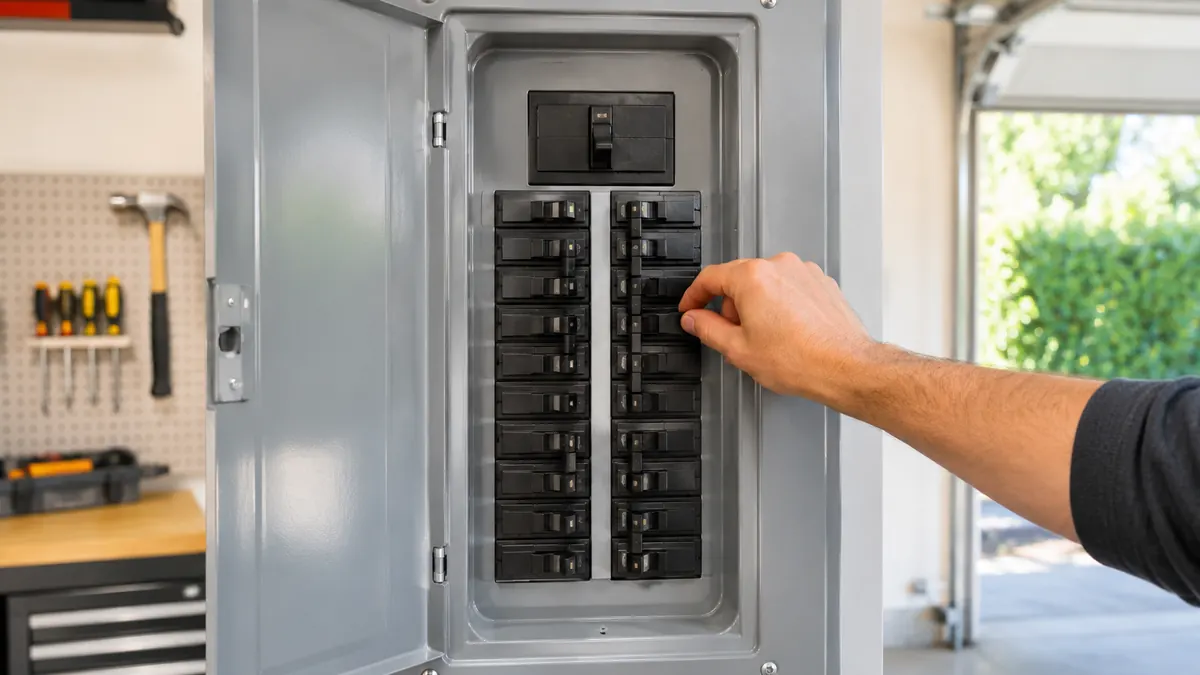
- Find the electrical panel, often in a garage, basement, utility room or hallway closet.
- Look for the tripped breaker. It will usually be in the middle position or pointing the opposite way to the others. Some have a red or orange indicator.
- Push it firmly to OFF. Many breakers won't reset unless you push them fully off first.
- Switch it back to ON. You should feel it click into place.
- Test the circuit, then plug devices back in one at a time.
Resetting a GFCI outlet
If an outlet in a bathroom, kitchen, garage or outdoor area stops working, the problem may be a GFCI outlet rather than the breaker. Look for an outlet with "Test" and "Reset" buttons, possibly in another room on the same circuit, and press "Reset" firmly.
The US Consumer Product Safety Commission's home electrical safety checklist recommends testing every GFCI once a month. Press "Test" and the power should cut off, then press "Reset" and it should come back on. If either step doesn't work, the GFCI should be replaced.
Advertisement
If it trips again
- It trips when you plug in or turn on one device: that device may be faulty or draw too much power. Try it on a different circuit, or have it checked.
- It trips when several things run at once: the circuit may be overloaded. Spread high-power devices across different circuits.
- It trips immediately with nothing plugged in: there may be a wiring fault. Leave it off and call an electrician.
- It won't stay on, or trips often for no clear reason: call an electrician.
Never tape a breaker on or replace it with a higher-rated breaker to stop it tripping. That removes the protection it provides and can cause a fire.
Label your panel
If the breakers in your panel aren't clearly labeled, it's worth taking time to label them. With a helper, switch off one breaker at a time and note which lights and outlets stop working. Clear labels save time when something trips and help in an emergency.
Advertisement
Warning signs that need an electrician
- Burning smells, scorch marks or warm outlets and switch plates
- Buzzing or crackling from the panel or outlets
- Lights that flicker or dim regularly
- Breakers that trip frequently
- An older panel that has never been inspected
Understanding circuit capacity
Each breaker has a number on its switch, such as 15 or 20. This is its amp rating, which is how much current the circuit can safely carry. Devices that heat or cool, such as space heaters, hair dryers, kettles, microwaves and window air conditioners, draw a lot of current. Running two or three of them on one circuit is a common cause of tripping.
If a breaker trips in the same room every morning, it may simply be that several high-power devices are used at the same time. Moving one to an outlet on a different circuit often solves it.
Advertisement
Avoiding overloads
- Don't plug space heaters into extension cords or power strips. Plug them directly into a wall outlet.
- Use power strips with built-in circuit protection, and don't plug one power strip into another.
- Replace damaged or frayed cords instead of repairing them with tape.
- Unplug appliances you aren't using, especially ones that produce heat.
Conclusion
Resetting a tripped breaker is simple: unplug devices on the circuit, push the breaker fully off and then back on, and add devices back one at a time. If it trips again straight away, trips often or you notice warning signs, leave it off and call a licensed electrician.
Common questions
Is it safe to reset a circuit breaker?
Usually, yes, if your hands are dry and the panel shows no signs of damage. If it trips again immediately, don't keep resetting it.
Why does my breaker keep tripping?
Common causes are an overloaded circuit, a faulty appliance or a wiring problem. Frequent tripping should be checked by an electrician.
What's the difference between a breaker and a GFCI outlet?
A breaker protects a whole circuit from overloads and shorts. A GFCI outlet protects people from shocks by cutting power when it detects a ground fault.
Sources and further reading
This guide is general information. Follow the manufacturer's instructions and safety advice. If you're unsure, call a qualified professional.